
Search Request | Object report
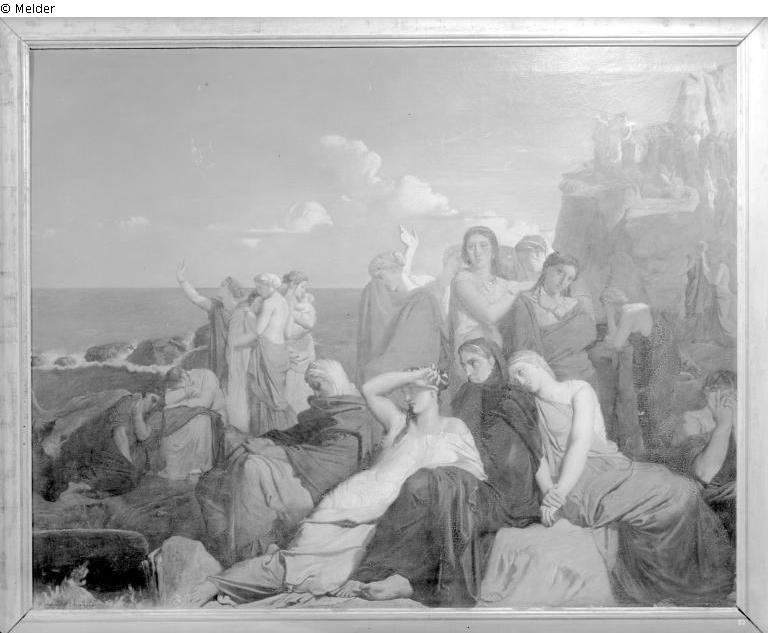
The Trojan Women
Lost Art-ID
606084
Artist / Creator
Chassériau, Théodore
Birth
1819.09.20, El Limón (Dominikanische Republik)
Death
1856.10.08, Paris
Place of activity
Paris; Rom
Title
The Trojan Women
Dating
1841
Object type
Group of reported objects
Material / Technique
Canvas
Height
168.00 cm
Width
216.00 cm
Description
signed
Provenance
Purchased by Ferenc Hatvany in France in 1909 (Bois Colombes, a castle near Paris) from a political party.; 1944, missing from the Hatvany Palace in Budapest; whereabouts unknown
It is unknown whether the loss during the Nazi persecution was caused by the German army, by the Soviet army, or by others.
Literature / Source
Bénédite-Dezarrois: Théodore Chassériau, sa vie et son oeuvre, Paris, 1931, p. 167; I. Genthon: Baron Ferenc Hatvany’s Collection of Modern Paintings. In: Magyar Művészet, XI, 1935, p. 8.; Kálmán Pogány: Complete Inventory of the Baron Ferenc Hatvany Collection, manuscript, 1932-1937. I /a. No. 7.; Mark Sandoz: Théodore Chassériau 1819-1856, Catalogue raisonné des peintures et estampes, Paris, 1974, p. 190, No. 90, Pl. LXXIII.; List of Art Treasures Removed from Hungary by the Germans. It is the so-called Bogyai List and indicates art that was still not returned to Hungary by March 1948. Ferenc Hatvany, No. 10, p. 4. (error re: size.); Inventory of Art Works Taken by the Germans, manuscript. A document sent to Karlsruhe by the Hungarian Ministry of Finance for the Hungarian Commission for Restitution dated October 3, 1947. Ferenc Hatvany, No. 4.;
Exhibited: Paris, Salon, 1842.; Ernst Museum, Budapest, 1913, XI. No. 43.; First Exhibition of Nationalised Artworks, Hall of Exhibitions, Budapest 1919. Room IV. No. 20.; Chasseriau Memorial Exhibition, Paris, Orangerie, 1933. No. 21.; The Countess Eva Almasy-Teleki Institute of Art, Budapest, 1940. Cat. No. 32.
Published since
Contact
Permalink to this page