
Found-Object Report | Object report
Wool knitting mill
Fragment
Lost Art-ID
634344
Title
Wool knitting mill
Additional title
Fragment
Dating
1450-1475
Object type
Group of reported objects
Material / Technique
Fabric (Wool) / knitted
Height
82.00 cm
Width
48.00 cm
Inventory number
LM-23633
Description
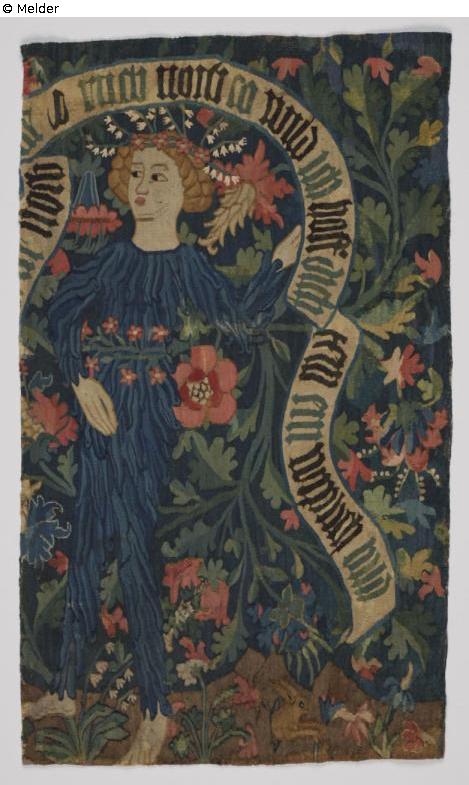
Fragment of a wool embroidery depicting a wild woman and a banner. In the background, green foliage with orange-red flowers. At her feet, a hare can be seen jumping out of its burrow. Fragment of the inscription on the banner reads: "[...] noch [...], ruch noch so wild/ich hoff dich zem ein wiplich bild"
Provenance
Since 28 April 1948 Swiss National Museum, Zurich, acquired from Kurt Meissner, Zurich; January 1948 – 28 April 1948 Kurt Meissner, Zurich, on commission for Baroness Herzog; circa 1947 – 28 April 1948 Baroness Herzog; 1944–1947 Confiscation of the Herzog collection by the Hungarian authorities in collaboration with the National Socialists; 13 June 1930–1944 Collection of Baron Mor Lipot Herzog, Budapest; undated–13 June 1930 Collection of Albert Figdor, Vienna; undated–undated Heilbronner brothers, Munich; [...]; 1450–1475, Switzerland.
The Swiss National Museum acquired the object in 1948 through the art dealer Kurt Meissner (1909–2004) from the estate of a certain Baroness Herzog (probably Erzsebet Weiss de Cespel-Herzog, 1898–1992) from Budapest. The baroness came from the family of Baron Mor Lipot Herzog (1869–1934) from Budapest, whose extensive collection was confiscated in 1944 after the Nazis invaded Hungary and installed a Nazi-aligned government. Some members of the Herzog family fled to the United States, while others did not survive the Second World War. After the war, part of the collection was restituted, but the Hungarian state imposed an anti-Semitic tax on all restituted assets, threatening renewed confiscation if it was not paid. In addition, export was prohibited until the tax was paid. At the same time, the family was destitute after the war and was therefore forced to sell many objects from the collection under pressure. For this reason, some of the works are still in Hungarian museums today. Legal proceedings in this regard are still ongoing. The communist regime that came to power in the post-war period also harassed the Herzog family. As members of the old bourgeoisie, they were also part of another enemy stereotype. In this case, it remains unclear why Baroness Herzog sold the tapestry. A connection with persecution-related confiscation cannot be ruled out.
Literature / Source
Peter Molnos, Lost Heritage, 2018, S. 275-345; Kurth, Betty: Die deutschen Bildteppiche des Mittelalters, Wien, 1926, Bd. 1, S. 220 & Bd. 2, Taf. 64.
Published since
Contact
Schweizerisches Nationalmuseum
Landesmuseum Zürich
Museumstrasse 2 / Postfach
8021 Zürich
Switzerland
Homepage
Contact
Contact
Permalink to this page